Knife Basics: The Grip, the Guide Hand and Five Cuts Worth Learning
You do not need a drawer full of blades or restaurant speed. A sharp chef's knife, a steady board and a few habits will make prep faster, safer and far less tiring.
Every new cook who comes through our test kitchen gets the same first lesson, and it has nothing to do with recipes. Before anyone touches an onion, we look at how they hold a knife, where their other hand goes, and whether their board slides around. Those three things decide whether prep feels calm or frantic. Speed comes later and mostly on its own.
One good knife, kept sharp
You can cook almost anything with a single chef's knife between 8 and 10 inches long, plus a small paring knife for fiddly jobs. Pick one that feels balanced in your hand and is heavy enough to do some of the work for you. Price matters less than you think. What matters far more is sharpness.
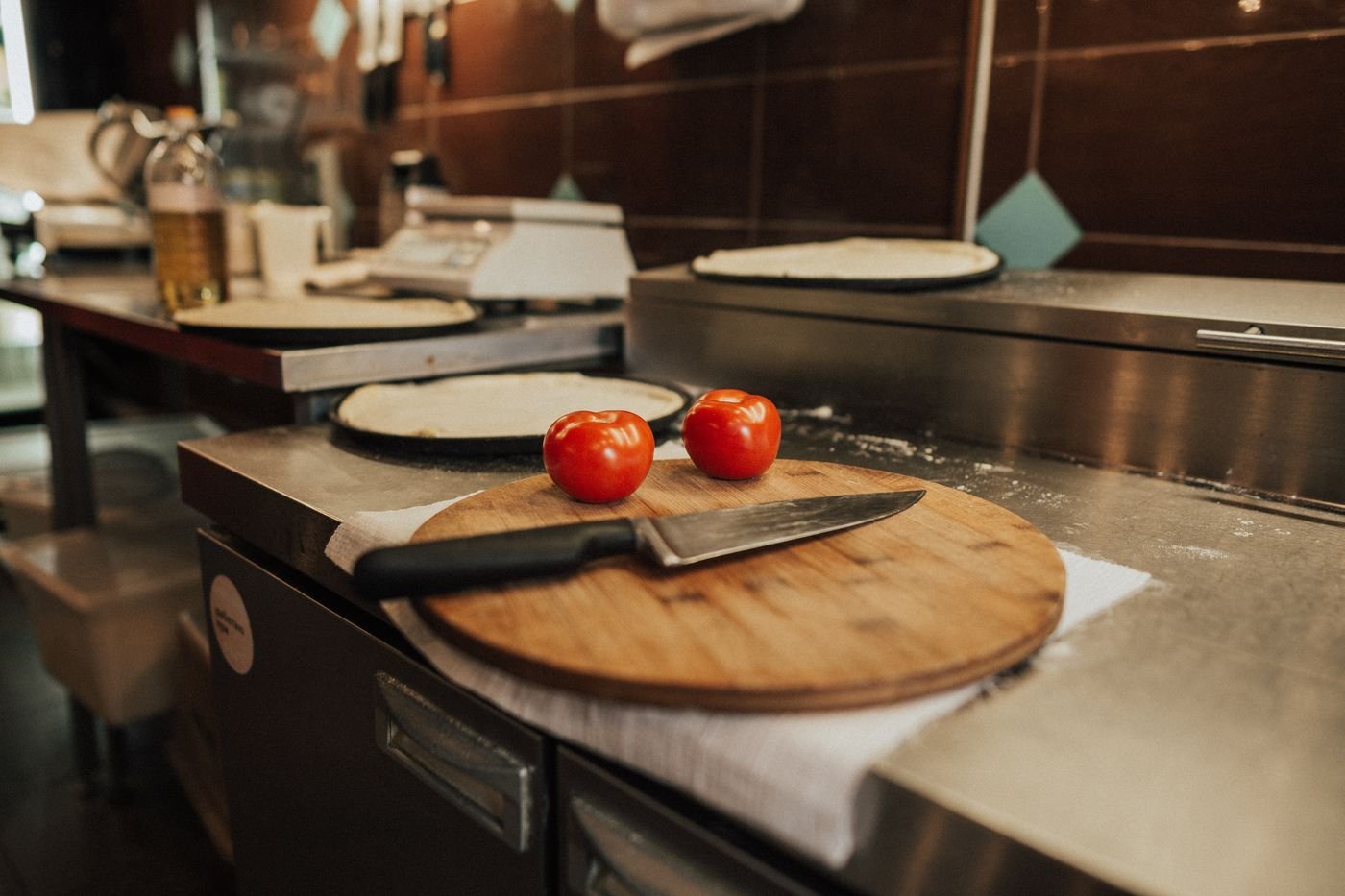
A dull knife is the dangerous one. It skids off the skin of a tomato or the curve of an onion and goes where you did not intend. A sharp knife bites where you place it. Use a honing steel every few sessions to straighten the edge, and have the knife properly sharpened, on a stone or by a professional, a few times a year. If a ripe tomato squashes before the blade breaks the skin, it is time.
Anchor the board
Before you cut, lay a damp paper towel or a thin damp cloth flat under your cutting board. It stops the board from sliding. A board that moves forces you to grip harder and brace oddly, and that is how people slip. Choose a board big enough that food is not falling off the edges. Wood and soft plastic are kind to your edge. Glass and stone are not.
The pinch grip
Most beginners hold a knife by the handle only, with the index finger stretched along the spine. It feels secure, but it gives you very little control of the blade's angle. Instead, choke up on the knife:
- Pinch the blade itself, just in front of the handle, between your thumb and the side of your bent index finger
- Wrap your remaining three fingers loosely around the handle
- Keep your wrist straight, so the knife becomes an extension of your forearm
This feels strange for about a week. After that, you will notice that the knife tracks in a straight line and your hand tires much less.
The guide hand
Your other hand is not just holding food still. It steers the cut. Curl your fingertips under slightly, into a loose claw, and rest them on top of the food. The flat of the blade should brush lightly against the knuckles of your middle and index fingers. Your knuckles set the thickness of each slice, and your fingertips stay tucked safely behind them.
Move the guide hand back a little after each cut rather than moving the knife forward to chase the food. The knife stays in roughly the same place and the food feeds toward it. That is the whole secret of even slices.
Rock, slide and let the tip do the work
For most cutting, keep the tip of the knife on or near the board and rock the heel up and down as you push slightly forward. The motion is a gentle forward arc, not a chop straight down. For tougher items such as squash, you can lift the whole blade and press down with a forward push. For soft herbs and delicate things, use a slicing pull so you cut rather than crush.
Five cuts worth learning
You do not need to memorize classic French dimensions. These five cover nearly every recipe we publish.
Slicing. Cut the food so it sits flat and stable first. A round carrot or potato rolls; halve it lengthwise and lay it cut side down. Then slice across with your knuckles setting the thickness.
Dicing an onion. Halve the onion through the root and peel it. Lay one half flat, make lengthwise cuts toward the root without cutting through it, then slice across. The root holds everything together until the last moment, and you get neat, even pieces with very little mess.
Mincing garlic. Crush the clove under the flat of the blade, peel it, slice it thinly, then rock the knife back and forth over the pile, gathering it up with the blade as you go. A pinch of salt on the board helps break it down.
Chiffonade. Stack leaves of basil or spinach, roll them tightly like a cigar, and slice across into fine ribbons. Use a very sharp knife so the edges do not bruise and darken.
Batons. Square off the sides of a vegetable, cut it into planks, then stack the planks and cut them into sticks. From there, cut across the sticks and you have cubes.
Habits that keep you safe
Never try to catch a falling knife; step back and let it land. Do not leave a knife in a sink of soapy water where someone cannot see it. Wipe the blade from the spine side, never along the edge. Scrape chopped food off the board with the spine of the knife rather than the edge, which dulls quickly when dragged sideways.
Practice on cheap vegetables. Ten minutes with a bag of onions or carrots, cut slowly and deliberately, does more for your skills than any gadget. Accuracy first, then consistency, and only then speed.